How Canada’s Supply Chain Issues Are Reshaping G7 Food Inflation Trends in 2026
Canada’s reputation as a stable, food-secure economy has been challenged by persistently high grocery prices. While food inflation followed the pandemic across all G7 nations, Canada experienced some of the most prolonged and severe increases. What began as a global shock has evolved into a structural issue driven by climate pressures, supply chain complexity, labor shortages, and concentrated retail power. Understanding Canada’s position requires examining deeper supply-side vulnerabilities and market dynamics beyond headline inflation figures.
Canada’s Food Inflation Crisis: Global Shocks and Structural Weaknesses
Canada’s food inflation surge is the result of global shocks colliding with long-standing structural vulnerabilities. While all G7 nations experienced rising food prices after the pandemic, Canada’s cost pressures were deeper and longer-lasting due to the way its food system is built.
-
Global Shocks and Input Cost Inflation: The COVID-19 pandemic, geopolitical instability, and supply chain disruptions reduced access to fertilizers, animal feed, and packaging materials. At the same time, energy price volatility increased costs for farming, food processing, refrigeration, and transportation across the entire supply chain.
-
Import Dependence and Price Exposure: Canada’s heavy reliance on imported fruits, vegetables, and processed foods—especially during winter—made domestic prices highly sensitive to global inflation and international logistics disruptions.
-
Geographic Scale and Transportation Costs: Vast distances between farms, processors, and consumers create long supply chains with high fuel and labor costs. Unlike smaller G7 economies, Canada cannot offset shocks through short-distance distribution.
-
Seasonality and Limited Supply Buffers: Seasonal agricultural production limits domestic supply for much of the year, increasing import dependence when global food prices are most volatile.
-
Retail Concentration and Price Pass-Through: A highly concentrated grocery sector allows rising upstream costs to be passed quickly and fully to consumers, reinforcing sustained food inflation.
Together, these factors transformed temporary global disruptions into a prolonged food inflation crisis across Canada.
Climate Change and Agricultural Costs Fueling Food Price Growth
Climate change has become a permanent cost driver within Canada’s agricultural system, reshaping how food is produced, priced, and supplied. Extreme weather events are no longer isolated disruptions but recurring pressures that raise costs across the entire food value chain.
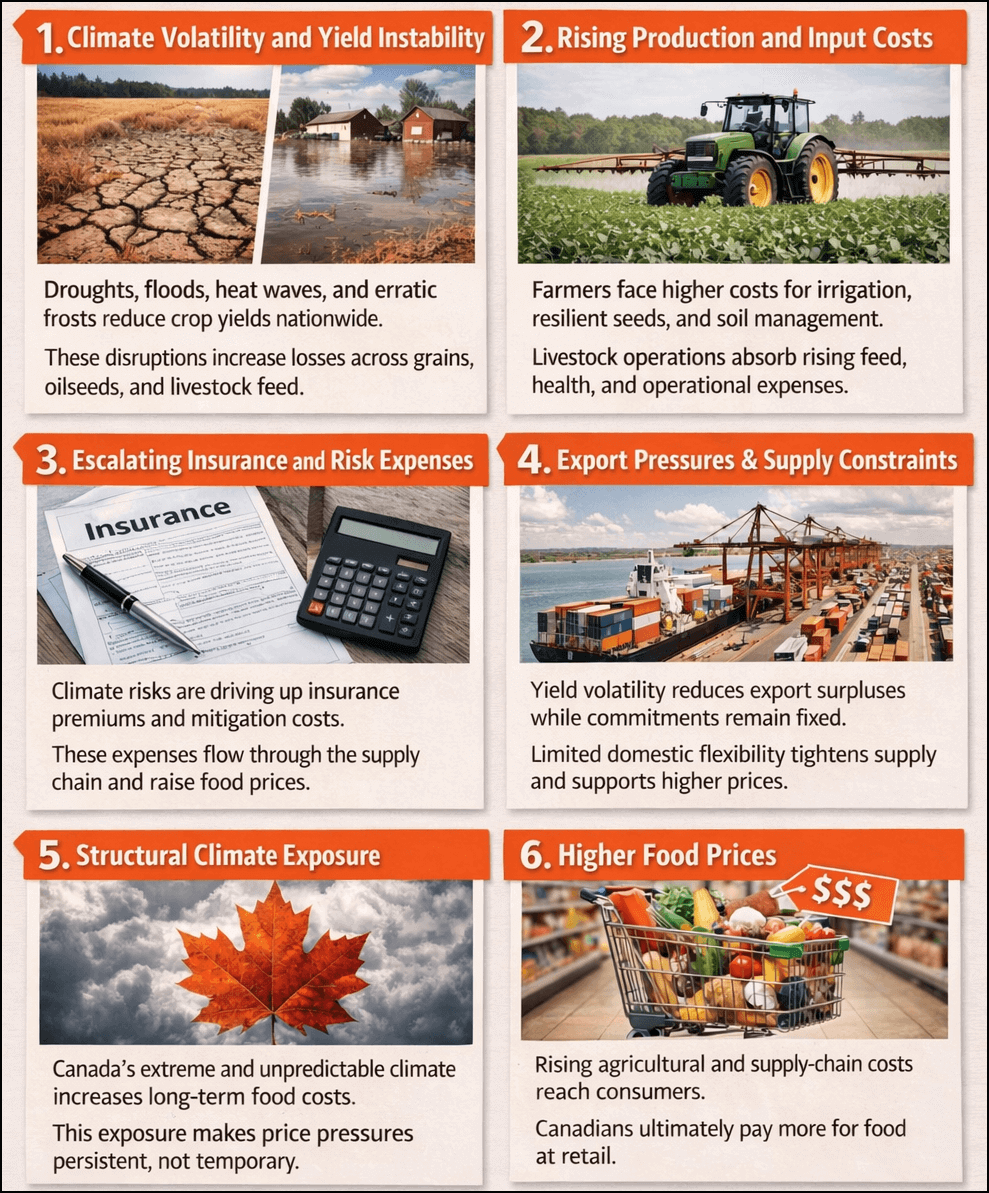
By embedding climate risk into production economics, Canada’s agricultural sector is reinforcing long-term food inflation, making climate resilience a central challenge for stabilizing future food prices.
Check out Canada’s QSR surge: how AI-driven kitchen automation is driving growth in a resilient foodservice industry, which highlights how AI and automation are accelerating growth in Canada’s QSR sector.
Supply Chain Inefficiencies, Transportation Costs, and Retail Power
Canada’s food supply chain faces structural challenges that significantly amplify food price inflation. Geography, infrastructure limitations, and market concentration combine to make logistics one of the most powerful cost drivers in the Canadian food system.
-
Geographic Distance and High Transportation Costs: Food frequently travels thousands of kilometers from farms to processing facilities, distribution centers, and retail shelves. Rising fuel prices therefore have a disproportionate impact on grocery costs, especially in remote and northern regions.
-
Infrastructure Bottlenecks and Capacity Constraints: Rail congestion, port delays, and limited trucking capacity increase transit times and operational uncertainty. These inefficiencies raise logistics costs, which are built into supplier contracts and passed through the supply chain.
-
Cold Chain Complexity and Energy Demand: Refrigerated and frozen foods require continuous temperature control over long distances. Cold chain operations increase energy consumption, equipment investment, and maintenance costs, while disruptions can result in spoilage, waste, and costly product replacement.
-
Retail Market Concentration and Pricing Power: Canada’s grocery sector is dominated by a small number of national retailers. While scale can improve efficiency, it also reduces price competition and limits supplier negotiating power, accelerating the pass-through of rising upstream costs to consumers.
-
Limited Price Absorption Compared to G7 Peers: Countries with shorter supply chains, stronger regional retail competition, or denser populations are better positioned to absorb or delay cost increases. In Canada, retail concentration and logistics intensity reinforce food inflation rather than buffering it.
Together, these structural supply chain factors have turned logistics costs and retail power into persistent accelerators of food price growth across Canada.
Labor Shortages and Regulatory Costs Driving Higher Grocery Prices
Labor and regulatory pressures have become structural cost drivers across Canada’s food system, directly contributing to sustained grocery price inflation. Persistent workforce shortages affect every stage of food production, processing, distribution, and retail.
-
Chronic Labor Shortages Across the Food System: Farms, food processors, warehouses, and grocery retailers face ongoing difficulty filling essential roles. Labor scarcity increases wages, recruitment costs, and overtime expenses while reducing operational efficiency and throughput.
-
Rising Costs in Agriculture and Food Processing: Agricultural labor shortages reduce harvest efficiency and raise per-unit production costs. Processing facilities often operate below capacity due to staffing gaps, increasing fixed costs per unit and driving higher wholesale prices.
-
Distribution and Retail Workforce Pressures: Understaffed distribution centers experience slower order fulfillment and higher labor costs, while retailers face increased wage bills and reduced service efficiency—costs that ultimately flow to consumers.
-
Regulatory Compliance and Administrative Burden: Food safety standards, labeling rules, environmental regulations, and labor compliance requirements are critical for public health and sustainability but add significant administrative and operational costs. Smaller producers and processors struggle to achieve economies of scale in compliance, intensifying cost pressures.
-
Structural Disadvantages Compared to G7 Peers: Unlike G7 countries with broader access to migrant labor or higher automation adoption, Canada faces tighter labor markets due to demographic trends, immigration constraints, and geographic dispersion. This creates a structurally higher cost base for food production and distribution.
Together, labor shortages and regulatory compliance costs reinforce long-term grocery price growth, making workforce resilience and operational efficiency central challenges for Canada’s food system.
Check out food costs in restaurants: the ultimate guide on how to manage, which explains cost control strategies, inventory management, pricing tactics, and operational best practices to improve profitability.
Canada vs the G7: Economic Impact, Consumers, and Policy Solutions
Canada’s food inflation differs from other G7 nations not only in how high prices rose but also in how long those pressures persisted. Comparing Canada with its peers highlights how structural factors, market dynamics, and policy responses shaped very different outcomes for consumers.
|
Metric |
Avg Food Inflation Peak (%) |
Duration of Elevated Prices |
Grocery Market Concentration |
Government Price Interventions |
Consumer Support Programs |
|
Canada |
High and persistent |
Long-lasting |
Very high (few dominant chains) |
Limited, indirect |
Targeted rebates, tax credits |
|
United States |
High but cooled faster |
Shorter duration |
Moderate |
Temporary subsidies |
SNAP expansion |
|
UK |
High during crisis |
Medium |
Moderate |
Energy & food support |
Cost-of-living payments |
|
Germany |
Moderate |
Shorter |
Low–Moderate |
VAT relief, subsidies |
Energy & income supports |
|
France |
Moderate |
Shorter |
Low |
Price caps, controls |
Direct price protections |
|
Italy |
Moderate |
Medium |
Low |
VAT reductions |
Household subsidies |
|
Japan |
Low to Moderate |
Long but controlled |
Moderate |
Strong price monitoring |
Wage & price coordination |
|
Disclaimer: The data and comparisons presented in this table are based on aggregated public reports, economic analyses, and industry observations. Figures and classifications are indicative and intended for informational and educational purposes only. They do not constitute financial, investment, or policy advice. Actual inflation metrics, government interventions, and consumer impacts may vary over time and by region. |
Summary: What Canada’s Food Inflation Reveals About the Future
Canada’s emergence as the leading food inflation nation in the G7 reflects deep structural pressures rather than temporary global disruption. Climate volatility, geographic complexity, labor shortages, and concentrated retail power have combined to keep grocery prices elevated.
Food inflation has become a long-term structural challenge, requiring sustained policy coordination, infrastructure investment, climate adaptation, and stronger market competition—rather than short-term price controls or interest rate tools alone.
Key Takeaways:
-
Food inflation in Canada is driven by structural weaknesses amplified by global shocks, not short-term market volatility.
-
Climate change has become a persistent cost driver, increasing production risk and tightening domestic supply.
-
Geographic scale and supply chain complexity elevate transportation and logistics costs across the food system.
-
Labor shortages and regulatory burdens have raised the baseline cost of food production and distribution.
-
Concentrated grocery retail markets accelerate the pass-through of rising costs to consumers.
For consumers, predictable grocery prices may no longer be the norm. For policymakers and industry leaders, the priority is building a more resilient and competitive food system capable of withstanding future economic and climate shocks.
Looking for a reliable source for commercial kitchen equipment parts in Canada? Shop with PartsFe CA and keep your kitchen operations running at peak performance. PartsFe CA simplifies maintenance by offering high-quality commercial kitchen equipment parts designed for durability and reliability. From motors, sensors, control boards, and valves to refrigeration, cooking, and ice machine components, with competitive pricing, fast Canada-wide shipping, and expert support.
Reference:
https://www.iisd.org/deep-dive/g7-crossroads-advancing-multilateralism-climate-environment-energy
https://www.state.gov/reports/investment-climate-statements/canada
FAQs
Why is food inflation higher in Canada than in other G7 countries?
Canada’s food inflation is amplified by long supply chains, climate exposure, labor shortages, import dependence, and concentrated grocery retail power.
Is climate change a major factor in rising food prices?
Yes. Extreme weather events increase production costs, reduce yields, and create supply uncertainty that raises prices across the food system.
Can government policy quickly reduce grocery prices?
Short-term relief is limited. Structural issues require long-term investment in infrastructure, competition, and climate resilience.
Are grocery retailers responsible for high food inflation?
Retailers pass on upstream costs, but market concentration can accelerate and magnify price increases.