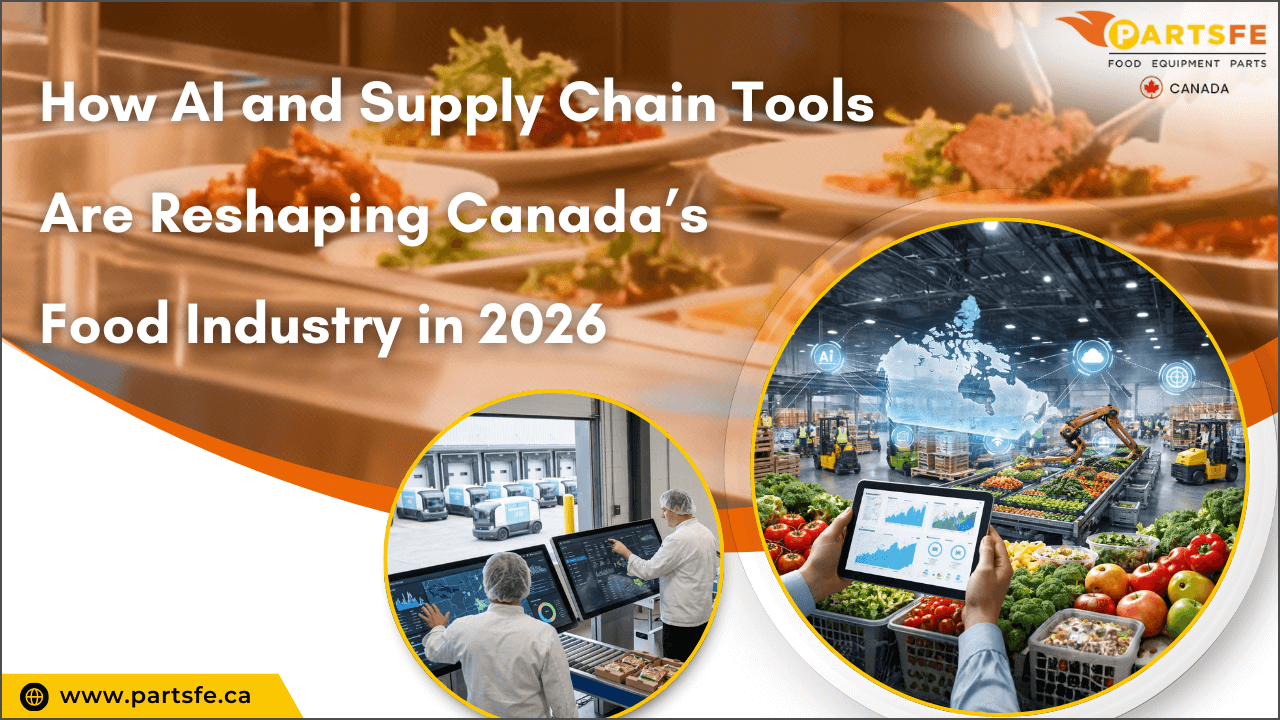
How AI and Supply Chain Tools Are Reshaping Canada’s Food Industry in 2026
Canada’s food industry is undergoing a major transformation in 2026 as rising costs, climate volatility, labour shortages, stricter food safety regulations, and growing demands for transparency place increasing pressure on the national supply chain. From farms and processors to distributors, retailers, and foodservice operators, every stage must operate with greater speed, precision, and resilience.
Artificial intelligence and advanced supply chain tools have moved from pilot projects to core operational systems, replacing manual, reactive processes with predictive analytics, real-time data integration, and automation. These technologies are reshaping how food is produced, forecasted, transported, stored, and delivered across Canada’s vast and complex food network.
The Changing Landscape of Canada’s Food Supply Chain
Canada’s food supply chain now demands intelligent, data-driven coordination to remain efficient, resilient, and responsive in an increasingly volatile operating environment. Vast geographic distances, seasonal production cycles, import dependence, and exposure to global trade disruptions have outpaced traditional supply chain models built on historical data and manual coordination.
-
Geographic Scale and Structural Complexity: Canada’s expansive geography creates long transit routes and fragmented regional supply chains. These structural constraints limit responsiveness and increase costs when relying on linear, disconnected distribution models.
-
Climate Volatility and Agricultural Uncertainty: Droughts in the Prairies, flooding in British Columbia, and unpredictable growing seasons in Ontario and Quebec have increased variability in agricultural output. Traditional planning methods struggle to adapt to these rapid, climate-driven fluctuations.
-
Rising Demand for Local, Sustainable Food: Population growth and urbanization are increasing demand for fresh, locally sourced, and sustainably produced food. This shift exposes the limitations of supply chains that depend on static forecasts rather than real-time demand signals.
-
Limits of Manual Coordination and Historical Planning: Legacy supply chains rely heavily on past data and delayed reporting, making them reactive by design. These systems often respond to shortages or surpluses after they occur, increasing waste and inefficiency.
-
Shift to Digitally Connected, Network-Based Supply Chains: AI-enabled platforms now connect farmers, processors, distributors, retailers, and regulators within shared data ecosystems. This connectivity allows stakeholders to anticipate disruptions, rebalance supply in near real time, and coordinate decisions across regions proactively.
-
Public and Industry Support for Digital Transformation: Government agencies and industry groups, including Agriculture and Agri-Food Canada, are supporting this transition through digital agriculture initiatives, food traceability frameworks, and innovation funding—making AI-driven supply chain modernization accessible beyond large multinational firms.
By replacing fragmented, reactive processes with intelligent, connected systems, Canada’s food industry is building a supply chain capable of adapting to climate pressure, shifting consumer demand, and global disruption—while improving efficiency, resilience, and long-term sustainability.
How AI Is Transforming Food Production, Forecasting, and Inventory Management
AI is redefining how Canadian food businesses plan, produce, and manage inventory in an increasingly volatile market. By replacing static, historical planning models with real-time, predictive intelligence, AI enables faster, more accurate decision-making across the food supply chain.
|
Operational Area |
Traditional Approach |
AI-Driven Approach in 2026 |
Business Impact for Canadian Food Companies |
|
Demand Forecasting |
Relied on historical sales data and fixed seasonal patterns |
Analyzes weather data, crop yields, pricing trends, promotions, and consumer behavior in real time |
Improved forecast accuracy, fewer shortages, and better alignment with regional demand |
|
Market Volatility Response |
Reactive adjustments after demand or supply disruptions occur |
Predictive adjustments triggered by external signals such as heatwaves or supply shocks |
Faster response to market changes and reduced disruption risk |
|
Production Planning |
Static production quotas set in advance |
AI optimizes batch sizes and production schedules based on live demand signals |
Reduced overproduction, lower spoilage, and improved margin control |
|
Ingredient Sourcing |
Manual planning with limited visibility into supply risks |
AI models balance sourcing decisions using forecast accuracy and shelf-life data |
More efficient sourcing and reduced raw material waste |
|
Inventory Monitoring |
Periodic manual checks and fixed reorder points |
Continuous monitoring across warehouses, DCs, and retail locations |
Better stock availability and lower holding costs |
|
Perishable Inventory Management |
All inventory is treated equally, regardless of age |
AI tracks remaining shelf life and flags at-risk products |
Improved freshness, reduced food waste, and higher customer satisfaction |
|
Inter-Facility Stock Transfers |
Manual decisions based on lagging data |
Automated recommendations based on demand and inventory imbalance |
Optimized stock movement across provinces and regions |
By shifting from reactive planning to predictive intelligence, AI enables food processors and distributors to operate with greater precision and confidence. These capabilities are especially valuable in Canada’s geographically diverse market, where demand patterns, climate conditions, and logistics constraints vary significantly by region.
As AI adoption deepens, forecasting, production, and inventory management will continue to evolve into fully integrated, self-adjusting systems—giving Canadian food businesses a decisive competitive advantage in 2026 and beyond.
Explore how AI technologies revolutionizing Canada’s local restaurants: driving Success from smart scheduling to chatbots and data analytics is reshaping daily operations, customer interactions, and decision-making through intelligent automation and data-driven strategies.
Smart Logistics, Cold Chain Monitoring, and Supply Chain Transparency
Canada’s food logistics network is one of the most demanding in the world, shaped by long transportation routes, extreme climate variation, and strict food safety standards. In 2026, understanding how AI-driven logistics, cold chain monitoring, and transparency tools function together explains why they have become essential for protecting food quality, reducing risk, and controlling costs across the supply chain.
-
AI-Driven Route Optimization and Cost Control: Smart logistics platforms use AI algorithms to optimize routing, carrier selection, and delivery scheduling in real time. By factoring in traffic conditions, weather forecasts, fuel prices, vehicle capacity, and delivery windows, these systems reduce transit time, lower transportation costs, and minimize delays that could compromise food quality.
-
Risk Reduction for Refrigerated and Frozen Goods: For temperature-sensitive products, even minor routing inefficiencies can cause temperature excursions. AI optimization ensures consistent transit conditions for refrigerated and frozen foods, significantly reducing spoilage, shrink, and insurance claims linked to cold chain failures.
-
Real-Time Cold Chain Monitoring with IoT Sensors: Cold chain monitoring has advanced rapidly through the use of IoT sensors embedded in trucks, containers, and storage facilities. These sensors continuously transmit temperature, humidity, and vibration data, providing uninterrupted visibility throughout transport and storage.
-
Predictive Alerts and Preventive Intervention: AI systems analyze sensor data to detect anomalies, predict refrigeration or equipment failures, and trigger corrective actions before food safety is compromised. This proactive approach allows operators to intervene mid-transit rather than discovering spoilage after delivery.
-
End-to-End Supply Chain Transparency: AI-enhanced, blockchain-integrated traceability systems provide complete visibility into product origin, handling conditions, and movement history. This transparency supports food safety compliance, sustainability verification, and ethical sourcing requirements.
-
Faster Recalls and Regulatory Compliance: Retailers and foodservice operators can trace products back to specific farms or processing facilities within seconds, enabling rapid recalls and accurate reporting. For regulators and auditors, AI-driven traceability improves oversight while reducing administrative burden.
By combining intelligent routing, continuous cold chain monitoring, predictive risk management, and full traceability, AI-powered logistics systems have become a foundational pillar of Canada’s modern food supply chain—strengthening safety, efficiency, and consumer trust at every stage.
Sustainability, Automation, and the Future of AI Adoption in Canada’s Food Industry
Canada’s food industry is undergoing a structural shift where sustainability and operational efficiency are no longer separate goals. Understanding how AI and automation contribute to environmental performance, labor resilience, and long-term competitiveness explains why these technologies have become essential to food operations in 2026.
AI-Driven Waste Reduction and Resource Efficiency: AI aligns production with real-time demand, reducing overprocessing, waste, and material loss while maintaining consistent supply.
Lower Emissions Through Intelligent Logistics and Maintenance: AI route optimization cuts fuel use and emissions, while predictive maintenance extends equipment life and reduces energy consumption.
Automation Addressing Chronic Labor Shortages: AI-powered automation handles repetitive tasks, improving efficiency, consistency, and workplace safety while reducing reliance on scarce labor.
Improved Food Safety Through AI Vision Systems: AI vision systems detect defects and contamination more accurately than manual inspection, strengthening food safety and reducing recall risk.
Barriers to Adoption and the Need for Support: High costs, integration challenges, cybersecurity risks, and skills gaps slow adoption, especially for smaller operators, highlighting the need for training and support.
AI as the Central Nervous System of the Food Supply Chain: As AI platforms mature, they will increasingly coordinate decisions across the supply chain, driving efficiency, resilience, and competitiveness.
By uniting sustainability, automation, and intelligent decision-making in a single operational framework, AI is shaping a more resilient, efficient, and future-ready food system—positioning Canadian food businesses to meet environmental targets while remaining economically competitive in the years ahead.
Explore how Canada’s QSR Surge: how AI-driven kitchen automation is driving growth in a resilient foodservice industry is transforming speed, consistency, and scalability by optimizing kitchen operations, labor efficiency, and data-driven decision-making.
Conclusion: Building a Smarter, More Resilient Food System
By 2026, AI and advanced supply chain tools have become essential to Canada’s food industry, enabling businesses to operate with greater agility, accuracy, and resilience amid rising costs, labour shortages, and regulatory pressure. AI-driven forecasting, inventory optimization, smart logistics, and real-time transparency are transforming how food moves from farm to fork, while automation and sustainability-focused analytics help reduce environmental impact, manage workforce challenges, and stabilize operational costs.
Key Takeaways:
-
AI has become a core enabler of resilience, allowing food supply chains to anticipate disruption rather than respond after it occurs.
-
Advanced forecasting and inventory optimization reduce waste, improve freshness, and strengthen supply-demand alignment.
-
Smart logistics and real-time transparency enhance food safety, traceability, and regulatory compliance across the supply chain.
-
Automation supports productivity and consistency while addressing ongoing labour shortages in food processing and distribution.
-
Food businesses that invest strategically in AI and supply chain modernization will gain a long-term competitive advantage in an increasingly data-driven industry.
As Canada’s food industry continues its transformation, AI will remain a critical driver of stability, innovation, and trust—defining how the sector competes, complies, and grows in the years ahead.
Summary:
In 2026, AI and advanced supply chain tools are transforming Canada’s food industry by improving forecasting, inventory management, logistics, and food safety. These technologies reduce waste, enhance transparency, address labour shortages, and support sustainability—creating a more resilient and efficient national food supply chain.
Looking for a dependable source of commercial foodservice equipment replacement parts? Shop now at PartsFe CA and keep your equipment performing at its best. At PartsFe CA, we make it easy to keep your operations running efficiently by supplying high-quality commercial kitchen equipment parts. From motors, sensors, control boards, and valves to refrigeration and ice machine parts, we stock reliable components from trusted brands to minimize downtime and extend equipment lifespan. With competitive pricing, fast shipping available across Canada, and knowledgeable support, we help you maintain reliable, uninterrupted operations.
Reference:
https://agriculture.canada.ca/en/sector/overview
https://openknowledge.fao.org/server/api/core/bitstreams/f1ee0c49-04e7-43df-9b83-6820f4f37ca9/content/state-food-security-and-nutrition-2023/technology-and-innovation.html
FAQs
How is AI improving demand forecasting in Canada’s food supply chain?
AI analyzes real-time data such as weather patterns, consumer demand, crop yields, and pricing trends to generate more accurate forecasts, reducing shortages, overproduction, and food waste.
What role does AI play in cold chain monitoring and food safety?
AI-powered systems monitor temperature, humidity, and equipment performance throughout transport and storage, enabling early intervention to prevent spoilage and ensure food safety compliance.
Why is AI adoption critical for the future of Canada’s food industry?
AI helps food businesses manage climate volatility, labour shortages, sustainability goals, and regulatory requirements, making supply chains more resilient, efficient, and competitive.