The Smart Waste Solution: Elevate Your Restaurant’s Sustainability with AI Insights
What if restaurant waste could be predicted? Food waste is a silent profit killer. It is driven by overproduction, inaccurate demand forecasting, and weak inventory control, resulting in spoilage, excess preparation, and inconsistent portioning that directly erode profit margins.
Traditional manual tracking methods often fail to capture these issues in real time, resulting in delayed or incomplete waste data. This makes it difficult to identify where waste is actually occurring in daily operations.
In this blog, we’ll show you how AI-powered waste analytics helps you tackle these challenges using real-time tracking, computer vision, and predictive forecasting, so you can accurately identify the sources of waste and make better, faster decisions in your kitchen.
Why Food Waste Is a Major Challenge for Modern Restaurants
Food waste is one of the most expensive inefficiencies in restaurant operations, directly affecting margins, compliance, and sustainability goals. According to Taking Stock report by Government of Canada, roughly 20% of food produced (≈11 million tonnes) is wasted annually, and restaurants contribute a significant share through overproduction, spoilage, and plate waste. Below are the key drivers behind this challenge:
-
High Operational Waste Levels: Foodservice operations commonly lose a substantial portion of purchased food, especially in categories like dairy and meat, driven by spoilage, over-preparation, and inconsistent demand.
-
Financial Impact: Wasted food creates major cost leakage through lost inventory value and additional disposal expenses, significantly reducing profit margins across individual restaurants and multi-location chains.
-
Environmental Burden: Food waste contributes heavily to greenhouse gas emissions, and when sent to landfills, it generates methane, a highly potent greenhouse gas that accelerates climate change.
-
Rising Disposal and Compliance Costs: In regions like Vancouver, strict organic waste diversion rules require businesses to separate food waste, increasing operational complexity and penalties for non-compliance.
Canada’s alignment with the United Nations Sustainable Development Goal 12.3 (50% food waste reduction by 2030) indicates tightening regulations ahead, likely leading to stricter compliance requirements and increased operational risk for restaurants.
The Role of AI-Powered Waste Analytics in Restaurant Operations
AI plays a critical role in modern restaurant operations by transforming raw waste data into meaningful insights that improve efficiency and reduce unnecessary costs. Below are the key ways AI-powered waste analytics are reshaping restaurant operations.
-
Real-time Tracking: Smart waste bins with integrated scales and cameras automatically log every disposal event in real time. This removes the need for manual entry, reduces human error, and ensures consistent tracking across all shifts, stations, and locations.
-
AI Food Recognition: Computer vision systems identify and categorize discarded food items such as proteins, vegetables, grains, and prepared dishes. They also separate avoidable waste (overproduction, spoilage, prep errors) from unavoidable waste (peels, bones, trimmings), helping kitchens pinpoint operational inefficiencies.
-
Example: Canadian company Intuitive AI’s “Oscar” system uses computer vision to identify waste items in real time and guide users to dispose of them correctly, helping improve recycling accuracy and reduce contamination at the source
-
Waste Visibility Dashboards: Tools like SkyTab’s reporting and analytics platform convert operational data into clear, actionable insights across menu items, kitchen stations, staff shifts, and time of day, helping restaurants identify inefficiencies and improve decision-making.
-
Predictive Demand Forecasting: AI models use historical sales, seasonal trends, weather, and customer behavior to forecast demand more accurately. This helps kitchens adjust prep volumes in advance and reduce overproduction during slower periods.
-
Cost Optimization: By revealing where waste occurs, restaurants can reduce unnecessary purchasing, improve ingredient usage, and refine portion control. This leads to lower food costs, improved inventory efficiency, and stronger profit margins.
Check out how AI and supply chain tools are reshaping Canada’s food industry in 2026 by boosting efficiency
How AI Waste Systems Continuously Improve Restaurant Efficiency and ROI
AI-powered waste systems convert real-time waste data into actionable insights, enabling continuous operational improvement, cost reduction, and stronger sustainability performance. The sections below outline the AI-driven waste cycle and its ROI impact.
AI Waste Improvement Cycle
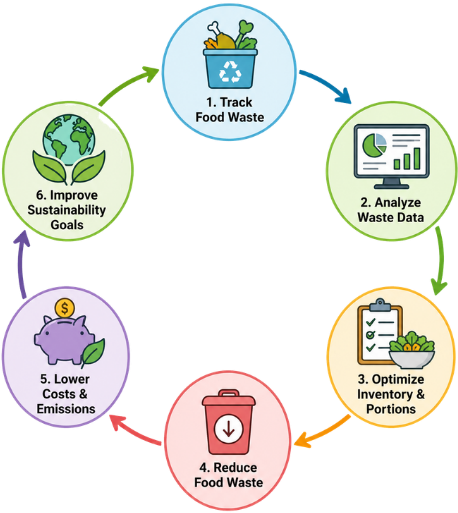
AI systems operate through a self-reinforcing feedback loop that turns waste data into operational improvements across the kitchen workflow, as shown in the diagram below.
-
Track Food Waste: AI-powered cameras, smart scales, and sensors monitor food waste in real time across preparation, cooking, and service areas, eliminating the need for manual tracking and improving data accuracy.
-
Analyze Waste Data: Advanced analytics identify waste patterns across ingredients, menu items, and kitchen workflows, revealing inefficiencies that are often hidden in day-to-day operations.
-
Optimize Inventory & Portions: Based on insights, restaurants can refine purchasing, portion sizes, and production planning to reduce over-ordering, spoilage, and excess preparation.
-
Reduce Food Waste: Operational improvements lead to more efficient kitchen practices, ensuring food is prepared in the right quantities and waste is minimized at the source.
-
Lower Costs & Emissions: Reduced waste directly lowers food costs and disposal expenses while also decreasing greenhouse gas emissions associated with food production and landfill waste.
-
Improve Sustainability Goals: The collected data supports ESG reporting, compliance requirements, and sustainability initiatives, strengthening brand reputation and demonstrating environmental responsibility.
ROI Comparison Table
The table below highlights the financial impact restaurants can achieve by implementing AI-powered waste tracking systems.
|
Waste Reduction Level |
Estimated Annual Savings |
Payback Period |
|
10% Waste Reduction |
~$21,000 |
~2 years 11 months |
|
30% Waste Reduction |
~$83,000 |
~10 months |
|
50% Waste Reduction |
~$145,000 |
~5 months |
Restaurants that achieve around 30% waste reduction often recover their investment in less than 1 year, while higher-performing operations can achieve even faster returns.
Find out how AI and IoT are solving 80% of food service challenges today by reducing waste and enabling real-time automation
The Future of Restaurant Management with Intelligent Waste Solutions
The next generation of restaurant operations will be increasingly data-driven, automated, and sustainability-focused. AI-powered waste systems are only the beginning of a broader transformation.
-
Predictive Kitchens: Future systems will integrate waste analytics with real-time ordering and inventory management. Instead of reacting to waste after it happens, restaurants will automatically adjust purchasing and prep levels to prevent overproduction.
-
Deeper Integration with Supply Chains: As AI systems evolve, they will connect directly with suppliers, enabling smarter procurement decisions based on predicted demand. This reduces over-ordering and minimizes spoilage before ingredients even reach the kitchen.
-
Circular Economy Models: Restaurants will increasingly participate in circular food systems, in which unavoidable waste is redirected for composting, bioenergy, or upcycled food products. AI will help identify which waste streams can be diverted most effectively.
-
Advanced ESG Reporting: As sustainability becomes a key business metric, restaurants will rely on AI-generated reports to track food-waste reduction, carbon savings, and compliance performance. This will support corporate sustainability goals and improve transparency for stakeholders.
-
AI Assistance: Future systems may include fully automated waste sorting, robotic kitchen assistants, and AI-driven menu optimization tools that design dishes based on waste efficiency and ingredient utilization.
Summary: Advancing Restaurant Efficiency with AI-Driven Waste Insights
AI-driven waste analytics is transforming restaurant operations by turning food waste data into actionable insights that improve efficiency, reduce costs, and strengthen compliance and sustainability performance. By combining real-time tracking, predictive forecasting, and advanced dashboards, restaurants can reduce inefficiencies and make more informed operational decisions across all levels of the kitchen.
Key Takeaways
-
AI-driven waste analytics turns food waste data into actionable insights that improve efficiency and profitability.
-
Real-time tracking with sensors and computer vision provides clear visibility into waste generation points.
-
Predictive forecasting helps reduce overproduction, spoilage, and poor inventory planning.
-
Dashboards break down waste by menu item, shift, and kitchen station for better decision-making.
-
Restaurants benefit from lower costs, reduced waste, and faster ROI.
-
The system supports compliance, ESG reporting, and long-term sustainability goals.
Shop now at PartsFe to keep your commercial kitchen equipment parts, including dishwasher parts, fryer parts, ice machine parts, oven parts, and plumbing parts designed for everyday operation.
References:
https://www.canada.ca/en/environment-climate-change/services/managing-reducing-waste/food-loss-waste/taking-stock.html
https://regulations.bonappify.com/regulations
FAQs
Is AI food waste management suitable for small restaurants?
Yes, AI food waste management solutions can be scaled for small restaurants, helping them identify waste patterns, reduce unnecessary costs, and improve overall operational efficiency.
Do AI systems replace human expertise?
No. AI supports decision-making by analyzing data and generating insights, but humans are still needed to interpret results and make final operational decisions.
Is staff training required to use AI waste systems?
Basic training is usually required so staff can input data correctly and follow AI-driven recommendations, but most platforms are designed to be intuitive and easy to adopt.
|
Disclaimer: This content is for general informational purposes only. AI system performance may vary based on implementation, and this should not be considered financial, legal, or operational advice. |